
I ching
Divination practice as cure for decision fatigue

Hi everyone,
Today I’m going to be writing about the I Ching, which I mentioned in my newsletter about revision.
To distill the methodology down to its most basic core (The I Ching for Idiots…), the I Ching is an ancient Chinese divination manual turned cosmological text, in which bundles of yarrow stalks are used to produce sets of seemingly random numbers. Each possible outcome, of which there are 64, corresponds to a hexagram, which is then looked up in the I Ching text to be interpreted.
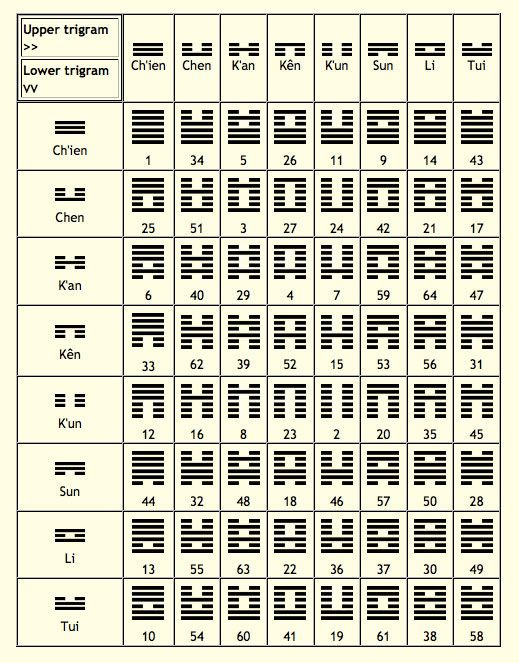
This method has been used for centuries to provide guidance for decision-making and moral setting. More recently, it has been further simplified and picked up in the West as a tarot-adjacent fortune-telling system.
I first learned about the I Ching through Sheila Heti, who explained her simplified method as a coin toss. You assign a “yes” and “no” value to heads and tails, ask the coin a question, flip the coin, and get your answer.
I first did the exercise one year ago, in January 2021. This was the result.
Q Am I supposed to be writing creative nonfiction?
A No
Q So I’m supposed to be writing poetry?
A No
Q Ok, fiction?
A Yes
Q Are you sure about that?
A No
Q Should I really trust you?
A No
Q Well let’s say I actually write a book of fiction. Will it be the story I’m working on now?
A No
Q Will it be about something I haven’t even thought of before?
A No
Q Ok, so I’ve thought of the idea before. Will it be about Sweden?
A No
Q Will it be a memoir?
A No
Q Ok so it’s not about me, but I’ve already thought of it before. Will it be a sci-fi novel?
A No
Q Thank god. Will it take me a very long time to write it?
A Yes
Q That’s what I was afraid of. Will it be very hard?
A No
Q Will anyone even like it?
A No
Q Alright, no one will even like it. Does that mean it won’t get picked up for publishing?
A Yes
Q Ok, so my next project is a bad novel that after I spend years writing, won’t even get picked up for publishing. What about after that? Will I ever get a book published?
A No
Q So I’m just supposed to write short pieces to get picked up by magazines that don’t pay anything for the rest of my life?
A Yes
Q I have to say this is becoming pretty disheartening. But then again, you did tell me not to trust you, and that you aren’t really sure about any of your answers. Will I ever go to grad school?
A No
Q Should I look at all of your answers above and think you’re actually saying the opposite?
A No
Q Ok, so I should take you at your word?
A No
Toward the end of the exercise, Sheila interjected to add one more note: make sure not to ask it anything you don’t want to know the answer to.
Touché.
Recommended Reads
Last month I read an interview between Rachel Cusk and Sheila Heti in The Paris Review from spring 2020.
In it, Cusk speaks about:
the 1st person POV
I felt that female experience needed to be directly owned. It needed to be an autobiographical “I,” and that in its most constricting and oppressive moments, the moral, psychological, and artistic problem of stepping outside the self, stepping outside “I,” was a place where you lost the relationship to the truth of your own experiences.
the intersection of being a writer and a mother
I had a shape suddenly, and I could express myself in it. I often think that if I hadn’t had children, I wouldn’t have been able to continue writing.
the clarity that comes with middle age
The thought that you’ve wasted your entire life in the service of things that didn’t really exist—that you were in a prison where the door, in fact, was open, and you’ve sat there all this time . . .
and the novel versus the memoir
You build a novel. You have to build it like a building so that it stays standing when you’re not in it. And the memoir is a different kind of contrivance. You are the building, and you use yourself as the building, and then other people can come and be in you for a bit. Because the point about having those experiences is that you feel, for instance, that you are the only person who has ever experienced [it].
I also really enjoyed Heti’s interrogation of what Cusk’s trilogy represents:
The trilogy has been universally praised for doing something thrillingly new with the novel form—a wonderful outcome, but also perhaps indicative of what Cusk suspected: that people would prefer an absent narrator to a specific, female one.
This interview made me even more excited to read Cusk’s book A Life’s Work, which is on my 2023 reading list.
With love,
Arielle
Yay someone funny on substack! Great job