
Recent reads
In my blue period

Hi everyone,
It’s been a while! Since we last spoke, something big and exciting happened:
~ I graduated ~
I’ll probably write more about my experience in school once I’ve had more time to fully absorb it all, but one thing about school is that it kept me from being able to read as much as I would have liked. I also didn’t get to write as much as I normally do. People are sometimes surprised by that—that the Reading and Writing program kept me from reading and writing. It’s mostly because you spend so much time reading your classmate’s work, and writing response letters to them.
Anyway, no matter the reason, I’ve been enjoying catching up on reading, and just overall being able to read whatever I want.
BOOKS
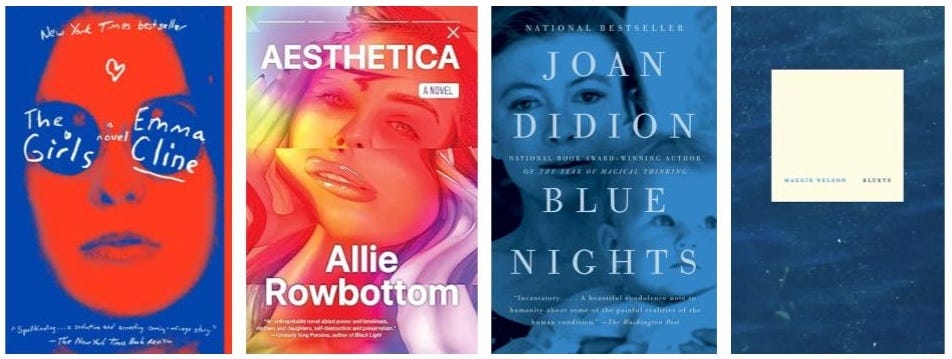
After the MFA ended, I was in the mood to read a fast book, some fluff. So I read Emma Cline’s The Girls, which wasn’t really fluff at all, though it was certainly fast. Cline writes such beautiful sentences. Then I wanted something a little more serious, so I read Allie Rowbottom’s Aesthetica, which turned out to be total fluff. I feel like I remember people loving this book a few years ago, and was really surprised as I was reading it. Everything felt so…obvious.
Now I’m reading Didion’s Blue Nights after having read The Year of Magical Thinking three Aprils ago and thinking it was the best book ever and meaning to read Blue Nights right away. Oops! Blue Nights is good, but I think there’s a reason everyone talks about The Year of Magical Thinking as THE definitive book on grief and never really mentions Blue Nights.
In keeping with the blue theme, I’m also re-reading Maggie Nelson’s Bluets along with the bookclub that David is in (someone in the book club said I look like “the kind of person who likes Sheila Heti”…fair). One of my favorite fun facts is that I know two girls who became friends because they saw each other at a coffee shop and noticed they shared a matching tattoo: the number 95, for the 95th and final page of Bluets. I read this book for the first time so many years ago. Something I forgot about it: my copy was a gift from a friend, her looping cursive inking itself in blue across the first page. Something I could never forget: the navy blue snake tattoo.
More blue: We’re listening to Joni Mitchell’s “Blue.” My friend Jenna keeps giving me books about water because she knows how much I love the ocean.
POLITICS
Like everyone else, I’m trying to keep up with the constant hellfire of the news cycle. Global, of course. National, obviously. All bad. But I’ve really been enjoying all the writing coming out about Zohran Mamdani and his recent sweep in the NYC mayoral primary.
One of my professors at Hunter, Mychal Denzel Smith, wrote about Mamdani and the “Black Vote” for The Intercept.
If young Black voters can play a deciding role in a Mamdani win come November, it may be a sign that the old playbook is no longer the only game in town. Politicians may have to do something they haven’t considered for decades: treat Black voters like they are people with real, material interests — informed by their experience of race and racism in the U.S., but material interests nonetheless.
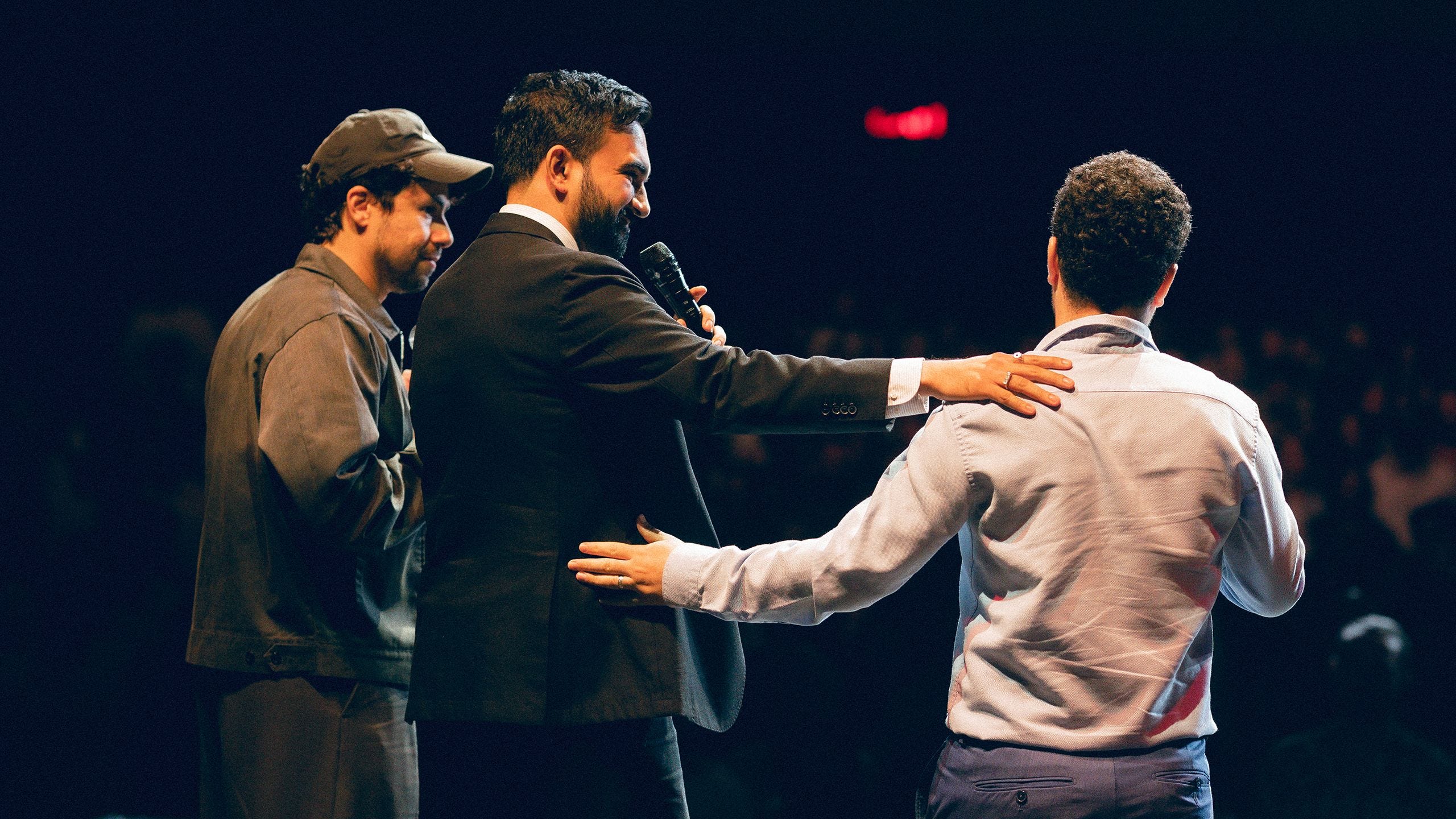
And anyone who knows me knows that I RAN, did not walk, to read the Hanif Abdurraqib piece on Mamdani and Mahmoud Khalil in The New Yorker. I am Abdurraqib’s #1 fan, as well as a huge supporter of both Mamdani and Khalil.
It was a delight to catch a glimpse of Khalil in the throes of laughter. He laughed as though each laugh were a physical vessel urgently exiting his body, or a secret he’d held for so long that it had forced its way out. Khalil’s body jerked forward when he laughed—his laughter was more of a kinetic event than a sonic one. He rocked, he shook slightly, and he smiled wide. One seat over, Mamdani laughed, too, with a bit more volume; his laughter seemed to arrive less like a long-held secret than like an idea that he couldn’t wait to share. Most of the audience didn’t know that the two men were in the room, and because of this most of the audience missed out on the small miracle of watching them share their joy at the scene before them.
My only gripe with the piece in The New Yorker was that the audio version was read by an auto-generated voice. Why! Give me Hanif and his inflection and passion and humility. Or give me literally anyone else. Any human. This piece deserved so much more than a robot’s dictation.
LENA DUNHAM
I am, for better or for worse, a Lena apologist. Not that I think she’s perfect—I think she puts her foot in her mouth way too much and sometimes says really stupid shit thinking she’s being funny—but I love her work and think she’s such an interesting and talented artist.
I read her interview with Mel Ottenberg in Interview Magazine, and was really taken with this quote:
I don’t go online very often, but if I ever dare to look at comments about myself, someone will say something like, “I can’t believe we made such a big deal about her when she was so small, and now she’s huge.” Doing Girls made me realize that there was literally no version of a female body, especially one that was getting naked in public, that was going to fly with people.
I think now and then of a boss I once had who used to have me buy lingerie for his girlfriend that he didn’t want to marry, and the comments he made about some women, and the comments he made about Lena Dunham, always along the lines of “That was a great show, but did she have to be naked so much?” As if he would have minded the nudity if she’d looked like a Victoria’s Secret model.
I’ve been thinking a lot lately about interviews and media training and whatnot, and something that struck me about this was how buddy-buddy Dunham and Ottenberg are. I kind of hate what that dynamic does to the interview. Besides a few good quotes on her end, this piece is mostly fluff and banter. It’s an interview that should have been a podcast, and it being a podcast would have been especially preferable because then I wouldn’t have listened to it. Because I hate podcasts.
I also read Lena Dunham’s piece in The New Yorker from back in May: Why I Broke Up with New York. It’s a “goodbye to all that”-type piece, which is a genre I tend to dislike, but I’m always struck by what a keen observer Dunham is. Which is obvious, I guess—one couldn’t write Girls and be inobservant.
My aunt Susan once said of my mother, “Laurie is a ‘from’ girl—the lox is from one place, the bagels from another, the flowers from someplace else.” Knowing how to get the best out of the city—from discount Manolos to vintage buttons to a ten-dollar blow-dry—gives my mother the satisfaction of a chess grand master stumping her opponent with a series of unexpected moves. But being a “from” girl is about more than the provenance of goods; it’s about living at such high speeds that your inner life can never quite catch up to you.
From girls unite!
OTHER
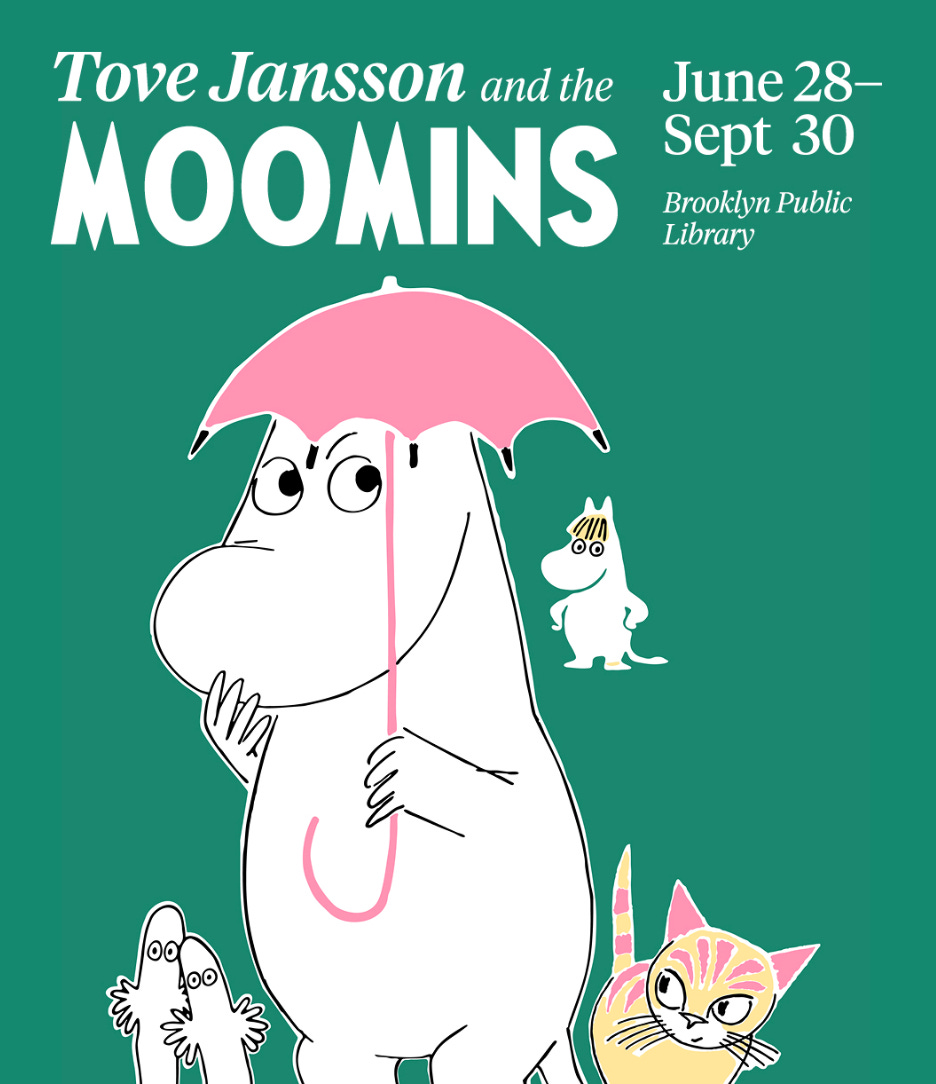
Besides all the reading, I also went to the Moomin exhibition at the Brooklyn Public Library in celebration of the books’ 80-year anniversary.
There was something about the Moomin show coupled with the recent defunding of PBS (and NPR and public radio) that especially pulled on my heartstrings. When I try to define myself the way someone on the outside might see me, or how another writer might describe me, I can see that I am probably somewhat grating at times and I know I can be stubborn and irritable and impatient and vain, but I know I am also filled with empathy and love and kindness and compassion. I know I am A Good Person. I am my worst parts because it’s hard to be alive and I am my best parts at least in part thanks to what I was raised on: the Moomins and Sesame Street. On ideas of acceptance despite differences and unconditional love and what it means to be a good friend and how to deal with loss and grief and fear.
I think of my friend who is pregnant and due in late October—my first pregnant friend: what will be left for her child in terms of TV, movies, and books? What will be left for her child’s child/children if they choose to have any of their own? It can’t all be copaganda dogs and the world’s most grating song about a baby shark. Kids aren’t stupid; they need media that treats them as the individuals they are, as people capable of true sadness and hurt, as people with equally valid feelings.
We’re losing everything, I think at my most cynical. How can we even hold onto what’s left?
Be well and stay kind,
Arielle
Congrats on your MFA. Can’t believe it went so fast!! And you were missed! Good to see you back!
Looking like you read Sheila Heti is the best way a person could possibly look. Congrats on graduating!